AdAttributionKit: Advanced Ad Tracking on iOS 18

The announcement of AdAttributionKit (AAK) by Apple at WWDC24 marks a major turning point in ad performance tracking on iOS. With this new framework, Apple aims to offer a more precise and flexible solution than SKAdNetwork (SKAN), while meeting strict privacy requirements. This article explores the features, differences with SKAN, and benefits for advertisers and developers.
Introduction to AdAttributionKit
AdAttributionKit was initially introduced with iOS 17.4, and all its features were unveiled at WWDC24 for availability starting with iOS 18. After the latest major versions SKAN 3 and SKAN 4, Apple is not launching a new SKAN 5 version of its attribution API, but rather a new framework dedicated to this topic: AdAttributionKit. This new framework is intended to progressively replace SKAdNetwork, which will lead to its deprecation. It comes in two variants:
- App AdAttributionKit: allows serving and attributing app install ads directed either to the Apple App Store or to alternative marketplaces.
- Web AdAttributionKit: this proposed framework represents a new version (mainly in terms of name) of Apple's Private Click Measurement (PCM) system.
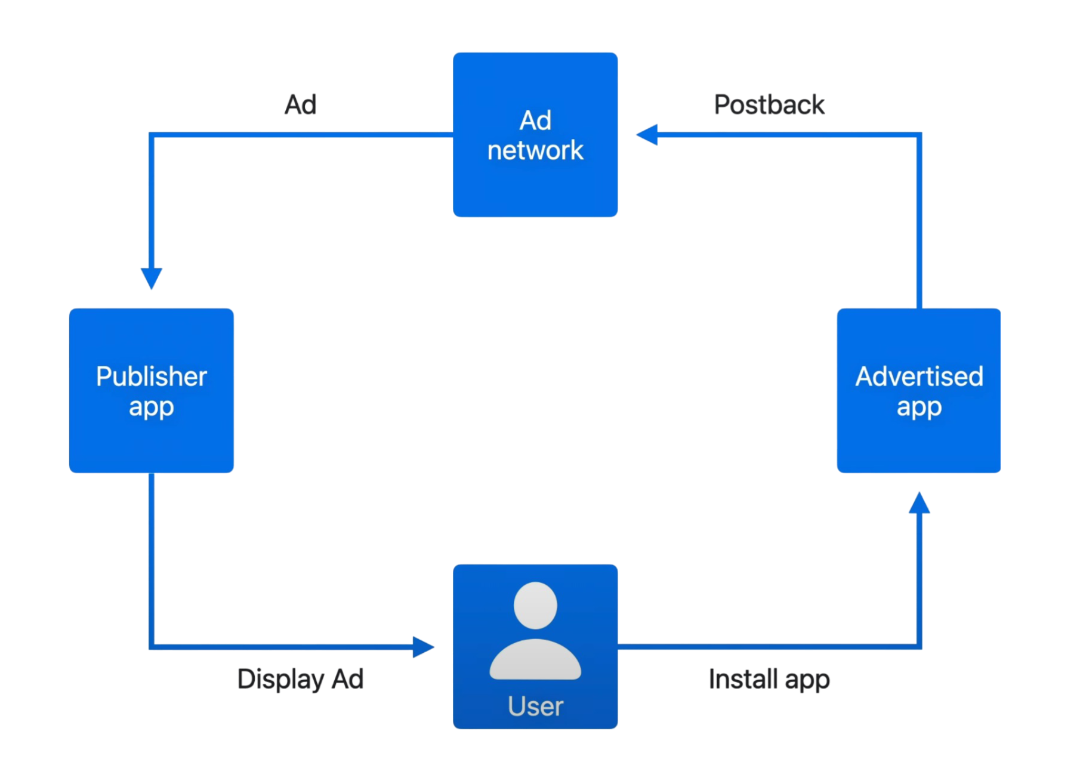
According to Apple, AdAttributionKit builds on SKAdNetwork features and "helps advertisers measure the success of their advertising campaigns while preserving user privacy." The essential difference between the two frameworks lies in the fact that AdAttributionKit (AAK) works for both the App Store and other app marketplaces, while SKAN only works with the App Store. If an app is available on store A (for example, the App Store) and another store B, the APIs can be called by both stores, and in case of impressions on store A and store B, Apple's system will sort and determine a winner.
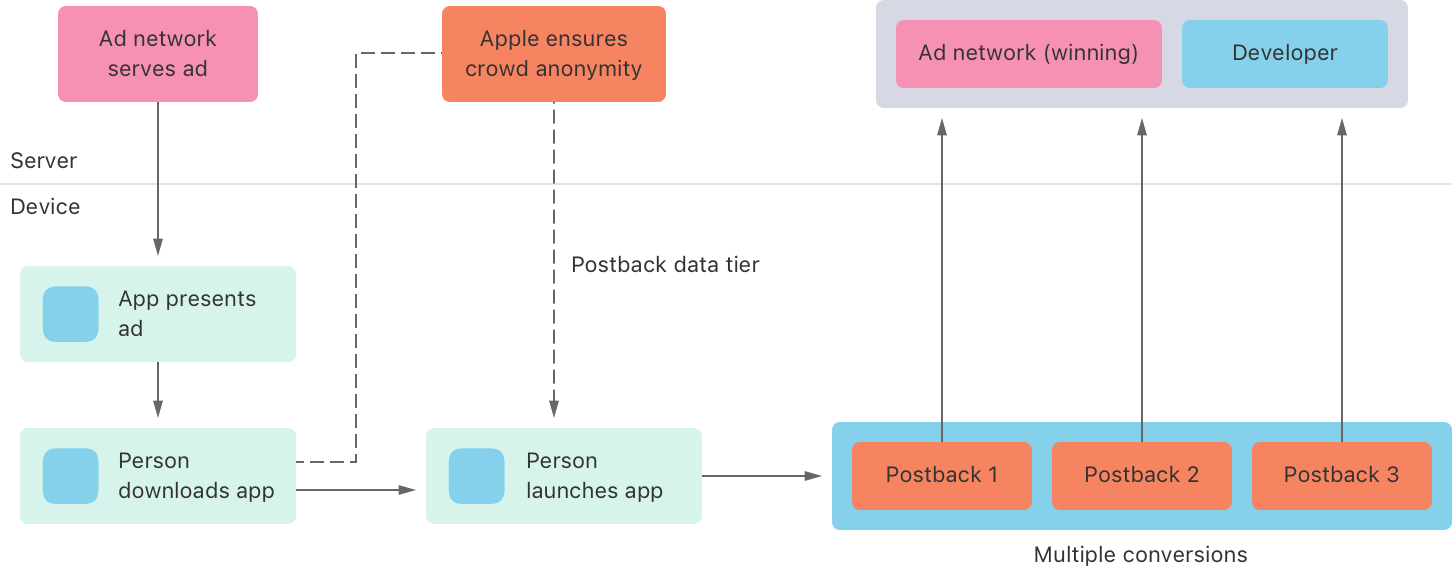
The attribution process for AdAttributionKit follows the same logic as previous versions of SKAdNetwork, notably with the system of postbacks sent to ad networks (winning or non-winning):
New Features
AdAttributionKit introduces new features, particularly concerning re-engagement:
- AAK introduces a new "conversion-type" postback field in the PostbackUpdate structure and can take three values: download, redownload, and re-engagement. This field helps with retargeting and re-engagement measurement, while not being dependent on an IDFA-type mechanism for user retargeting.
- A Dev Mode is available to help developers debug the implementation, notably by reducing the postback window for development applications.
AdAttributionKit also introduces new schemas to categorize ad placements and measure conversions:
- Custom click ads: these ads are used to promote apps distributed on the App Store or on an alternative marketplace.
- View-through ads: these ads require a minimum viewing time of 2 seconds for video tracking and are used to promote apps distributed on the App Store or on an alternative marketplace.
- SKOverlay: used to promote apps on the App Store, these ads expand into a partial takeover and can be installed directly from the ad.
- SKStoreProductViewController: these ads support view or click engagements and are used for non-app media, such as an app's product page.
Attribution windows for view-through ads are set at 24 hours, while click engagements have a 30-day attribution window.
The new conversion type signals, particularly re-engagement, will be very useful for certain campaigns. Post-view measurement with the view-through ads format will also allow going further to optimize acquisition campaign performance.
AdAttributionKit vs. SKAN: What Are the Main Differences?
Alternative App Store Support
Unlike SKAN, which is limited to Apple's App Store, AdAttributionKit extends its support to alternative marketplaces. Available from iOS 17.4, this feature allows cross-app store attribution, thus increasing the reach of advertising campaigns across various platforms.
This evolution occurs in the context of the Digital Markets Act (DMA), a regulatory obligation that notably forced Apple to end its App Store monopoly for app distribution on iOS. Learn more about the DMA in our expert note dedicated to Consent Mode v2.
The immediate impact is limited by the small number of alternative marketplaces currently active, but this offers significant future opportunities. Stay tuned 👀
Re-engagement Measurement
AdAttributionKit integrates re-engagement capabilities, allowing tracking of conversions from ads clicked by users who have already installed the app. This feature centralizes attribution, simplifying reports and encouraging wider adoption.
For now, only click attribution is available for re-engagement: view attribution is not available for re-engagement.
New Developer Mode and Enhanced Fraud Prevention
AdAttributionKit introduces a developer mode that simplifies the app measurement and testing process. This mode provides real-time data and debug information, facilitating the identification and correction of attribution issues. Additionally, stricter anti-fraud measures have been implemented, such as the requirement to display ads in the foreground and limiting the use of timers to prematurely end impressions.
With these improvements, Apple is trying to strengthen the integrity and accuracy of advertising measurements. For developers, this new mode can accelerate the testing phase, while anti-fraud measures ensure more reliable engagement metrics.
Conclusion
AdAttributionKit represents a significant advancement in advertising performance tracking on iOS. By offering a more precise, fast, and flexible solution, while respecting Apple's stricter privacy standards, AAK meets the new needs of marketing and technical teams in a context of signal limitations to respect user privacy choices.
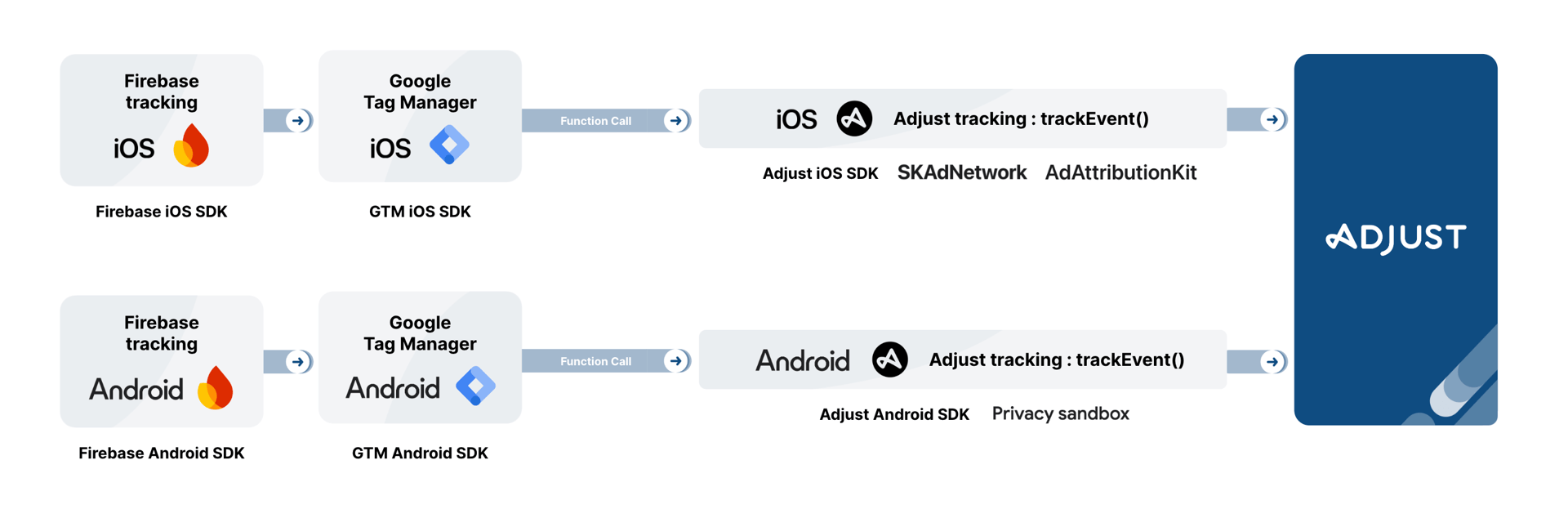
To remain competitive in the app marketing world, it is essential to understand and adopt Apple's new AdAttributionKit framework. Apple's AAK and SKAN solutions constitute very interesting complementary alternatives to historical attribution methods used by tools like Adjust and AppsFlyer, which rely on IDFA subject to ATT acceptance. Adjust and AppsFlyer already use SKAN signals and will surely soon integrate AAK signals, in addition to IDFA signals.
Sources and Useful Links
- https://developer.apple.com/documentation/AdAttributionKit
- https://developer.apple.com/documentation/adattributionkit/adattributionkit-skadnetwork-interoperability
- https://developer.apple.com/videos/play/wwdc2024/10060/
- https://www.adjust.com/blog/adattributionkit/
- https://www.appsflyer.com/glossary/adattributionkit/
- https://www.appsflyer.com/blog/mobile-marketing/ad-attribution-kit-wwdc24/
- https://upptic.com/adattributionkit-positioned-to-replace-skan/
- https://www.singular.net/glossary/adattributionkit/
- https://www.adjust.com/glossary/crowd-anonymity/
More notes like this one?
We publish regularly on LinkedIn what we learn in the field. The algorithm doesn't favor us, so hit the bell to make sure nothing slips through.