Marketing & AI:
From experimentation
to performance

Artificial intelligence and prediction

AI is not an end in itself, it is a performance lever. EdgeAngel helps you move from 'buzz' to business by deploying pragmatic, secure AI solutions connected to your data.

AI Agent Core
Context
Data
Processing... 98%
Efficiency
10x Faster

Our Marketing & AI services

01 / 04

Our Approach: AI Serving Data and Marketing

At EdgeAngel, we adopt a pragmatic and ROI-oriented approach. For us, AI is not an end in itself; it is a powerful tool that, to deliver its full value, must be anchored in a robust data and marketing strategy.

We help you see clearly, identify profitable AI use cases, and deploy AI marketing solutions that generate direct value for your organization.

01.

AI, Data & Marketing
Expertise

Essential for driving and optimizing marketing, maximizing performance, and limiting regulatory risks.

02.

Premium
Consultants

Responsive, proactive with solid and proven expertise in AI & digital marketing data (and we're nice!).

03.

Personalized
Collaboration

EdgeAngel adapts to your organization for a tailor-made and efficient collaboration.

Tailor-made support

Our data and AI experts guide you to transform AI potential into real performance

  • HĂ©lène Somdecoste-Lespoune

    Hélène Somdecoste-Lespoune

    Experte en Data Marketing et Analyses CRO

    Hélène identifie les cas d'usage marketing (scoring, audiences prédictives, personnalisation) où l'IA peut générer un impact business immédiat et mesurable.

  • Mathieu Lima

    Mathieu Lima

    Lead Technique Data Engineering

    Mathieu est le garant de l'implémentation. Il pilote le développement des agents IA sur mesure et assure leur intégration technique dans vos flux de données (pipelines, API).

AI Technologies

OpenAI, Gemini, Claude, Agents

  • Google Cloud Vertex AI

    Platform to build, deploy, and scale ML models.

  • BigQuery ML

    Create and execute ML models directly in BigQuery using SQL.

  • OpenAI API

    Integration of GPT models for content generation and semantic analysis.

  • Hugging Face

    Access to thousands of open-source models for specific tasks (NLP, Image).

Ready to accelerate your growth?

Let's discuss your data and marketing challenges. We'll respond within 24 hours.

Paul Schmitt

Paul Schmitt

Consulting Director

"Our goal is to make your data actionable to generate concrete value, quickly."

Any questions?

The question isn’t about “doing AI,” but knowing where AI creates measurable business value. The approach involves analyzing your marketing chain (acquisition, conversion, CRM, reporting, user experience) to identify repetitive, time-consuming tasks or those dependent on manual interpretations. These are the areas where AI generates immediate impact.

Prioritization is based on three criteria:

  • Expected business impact (conversion, basket size, LTV, acquisition costs, time saved).

  • Technical feasibility (data quality, marketing maturity, existing tools).
  • Speed of implementation (quick-win vs. advanced use case).
Examples of quick-ROI use cases:
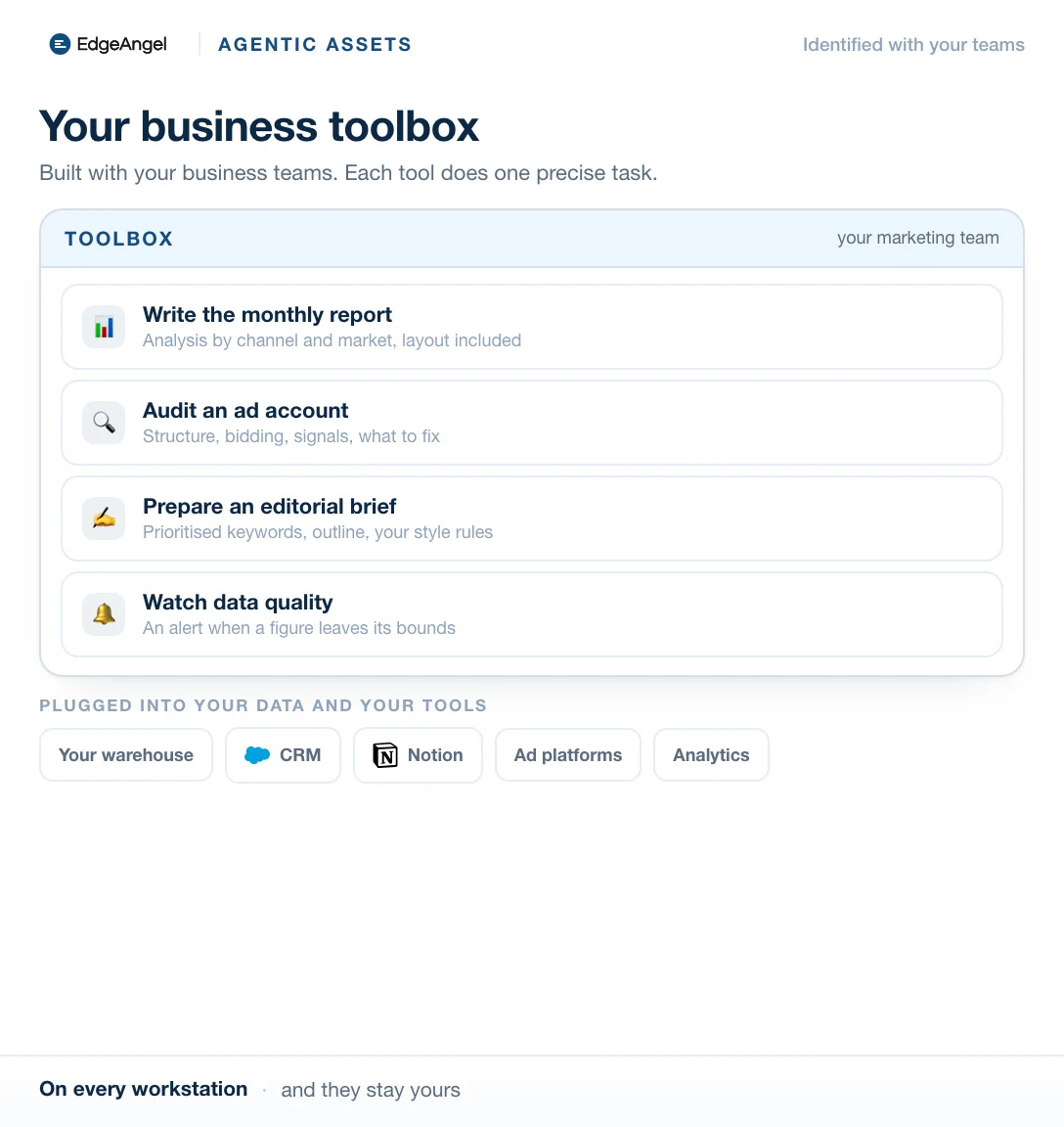
  • Predictive scoring and segmentation for CRM / Paid Media.
  • Automated reporting and insight extraction.
  • Customer verbatim analysis for product and CX prioritization.
  • Marketing content generation and optimization (SEO, SEA, Social Ads).
  • Product recommendations / personalized content.
The EdgeAngel approach: identify a high-performing use case, deploy it quickly, measure the impact, then extend AI to other teams—moving from experimentation to performance.

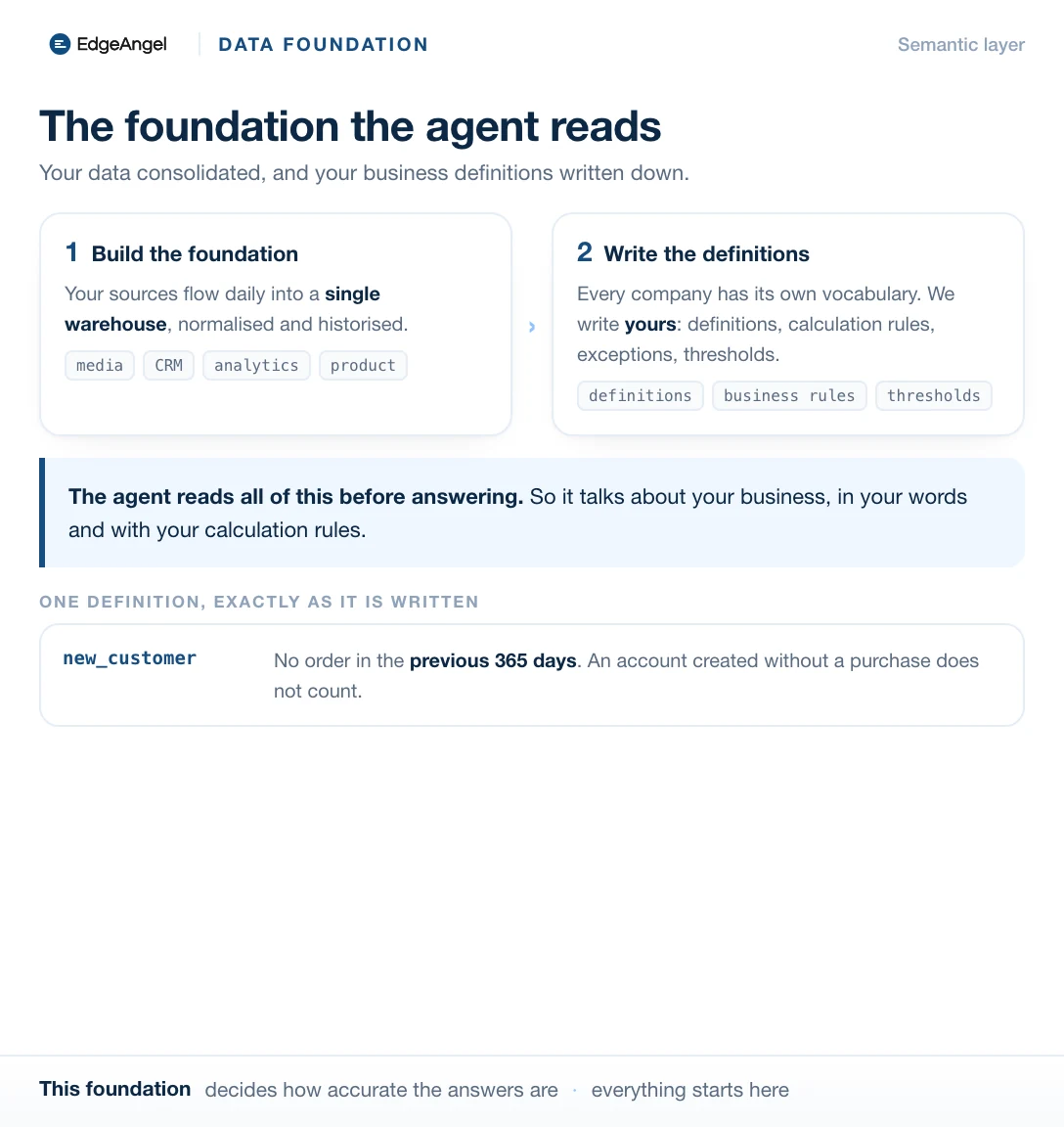
It is not mandatory to have a Modern Data Stack to start a first AI use case. However, the performance and reliability of results depend directly on the quality and structure of available data. AI works well on rich, contextualized, fresh, and consolidated data; it works poorly on scattered, incomplete, or unreliable data.

In practice:

  • without a solid data foundation, AI produces approximate insights, inconsistent recommendations, and hard-to-exploitations;
  • with a reliable data foundation, AI becomes a true accelerator of marketing and business performance.
That’s why we support both:
  • organizations already equipped with a data architecture,
  • and those wishing to structure their collection, DWH, and pipelines to maximize AI impact.
So you can start now, and strengthen your data stack in parallel to extend AI’s impact across the company.

AI improves marketing performance at three levels:

  • it saves time by automating manual and repetitive tasks;
  • it optimizes actions by improving targeting, segmentation, content, and customer journeys;
  • it allows predicting behaviors and anticipating marketing decisions rather than reacting to them.
Concretely, AI can increase CRM conversions, improve media efficiency, enhance audience relevance, accelerate insight generation, and significantly reduce acquisition costs. The companies achieving the best results are those that don’t just “use AI,” but integrate it into their marketing data and operational processes so it directly fuels execution.

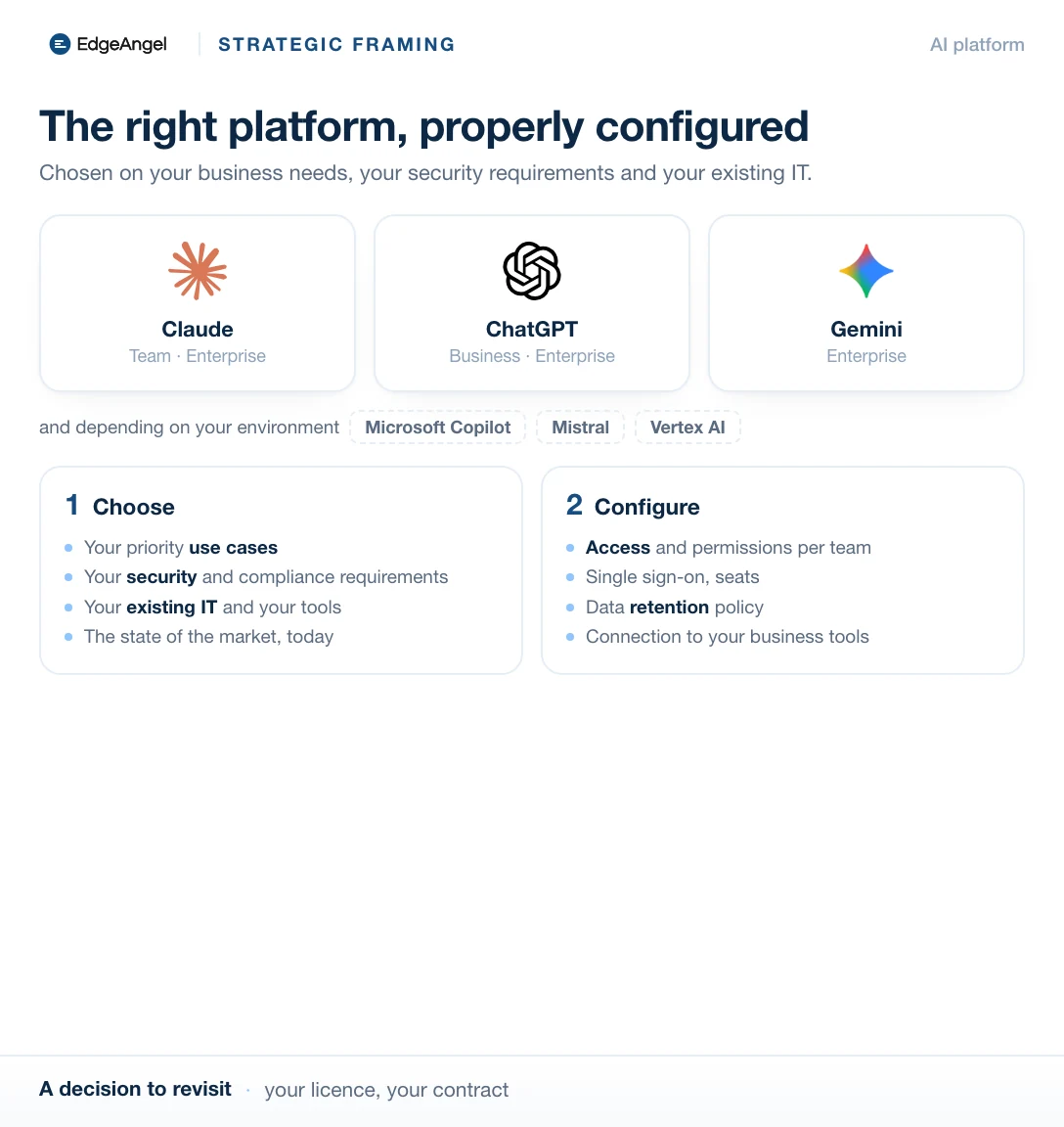
There is no universal “best AI platform.” The choice depends on the company’s context, security constraints, priority marketing use cases, and existing tools. Some platforms excel in creative uses, others in reasoning, and others in integration with first-party data.

Our role is not to push one tool over another, but to select in a completely agnostic way the AI platform that maximized marketing and business value. Depending on the organization, this could be ChatGPT Business/Enterprise, Google Gemini Enterprise via Vertex, Claude, or open-source models for sovereignty and cost control issues. The stake is not choosing a tool, but choosing the one that will deliver a concrete and measurable ROI on marketing uses.

No, successful AI adoption should not add complexity for marketing teams. Marketing's role is to define the business need, guide the AI agent with business instructions, interpret results, and steer performance. The technical role is to make AI usable without friction: platform configuration, data connection, security, governance, and automation.

That’s why we create specialized AI agents by trade, usable via simple interfaces (prompt, chat, dashboards, automations), which leverage model power without requiring coding or integration skills. When AI is deployed well, marketing teams gain autonomy instead of adding an extra technical layer.

AI in a professional environment must strictly respect security, governance, and compliance requirements (GDPR, privacy by design). Risks appear when using public tools, without prompt control, without permission policies, or without control over where data transits.

To avoid this, we only deploy secure enterprise AI environments that guarantee:

  • confidentiality of prompts and used data;
  • no use of data to train public models;
  • governance of access and permissions by team;
  • human supervision, monitoring, and cost optimization.
The company remains the owner of the data and fully controls usage—AI becomes an accelerator, not a risk.

It all depends on data maturity and the use case scope. Some projects offer quick ROI in a few weeks when they rely on already structured data and a well-defined marketing scope. Others require more work to connect AI to internal data, CRMs, a DWH, or business tools.

Our approach aims to avoid “mammoth” projects without visible results. We systematically prioritize a first use case deployed quickly to demonstrate impact. It then becomes the foundation for extending AI to other teams, channels, and marketing activations. The pace of progress depends on the company’s ambition, but always with the same guiding thread: produce value, measure, optimize, extend.

Yes, we don’t sell AI that we don’t practice.

AI is integrated into all our work: campaign optimization, predictive scoring, insight automation, data analysis, copilots for our consultants, code generation, audit production, and recommendations. This allows us to identify what really works, what doesn’t, and what generates real value on the client side. The AI solutions we deploy are all derived from what we use daily.