
Six months. That is roughly how long it takes, at many of our clients, between an AI demo that impresses the whole executive committee and the quiet abandonment of the tool that was supposed to carry it. We have seen it happen often enough to stop being surprised. The problem is almost never the model. It is the absence of everything that should surround it: the data, the use cases, the rules, the adoption.
At EdgeAngel, a data marketing consulting firm, we deploy these systems for our clients (advertisers, SMBs and large accounts alike) and we have been running them ourselves in production for more than two years. This note shares what we have learned. Some of the advice will be outdated within a year; the logic behind it will not: choose a platform, and build your use cases on it as personalised, portable, governed assets.
We will go in this order: the solutions landscape, what to activate depending on your size, how we organise ourselves, a real use case end to end, and where you start.
The AI solutions landscape: four families to know
The landscape moves every quarter. The names mentioned here date from summer 2026, some will already have changed by the time you read this, and that is perfectly fine: what matters is the reading grid, not the ranking of the moment. For data and marketing use cases in a company, we distinguish four families.
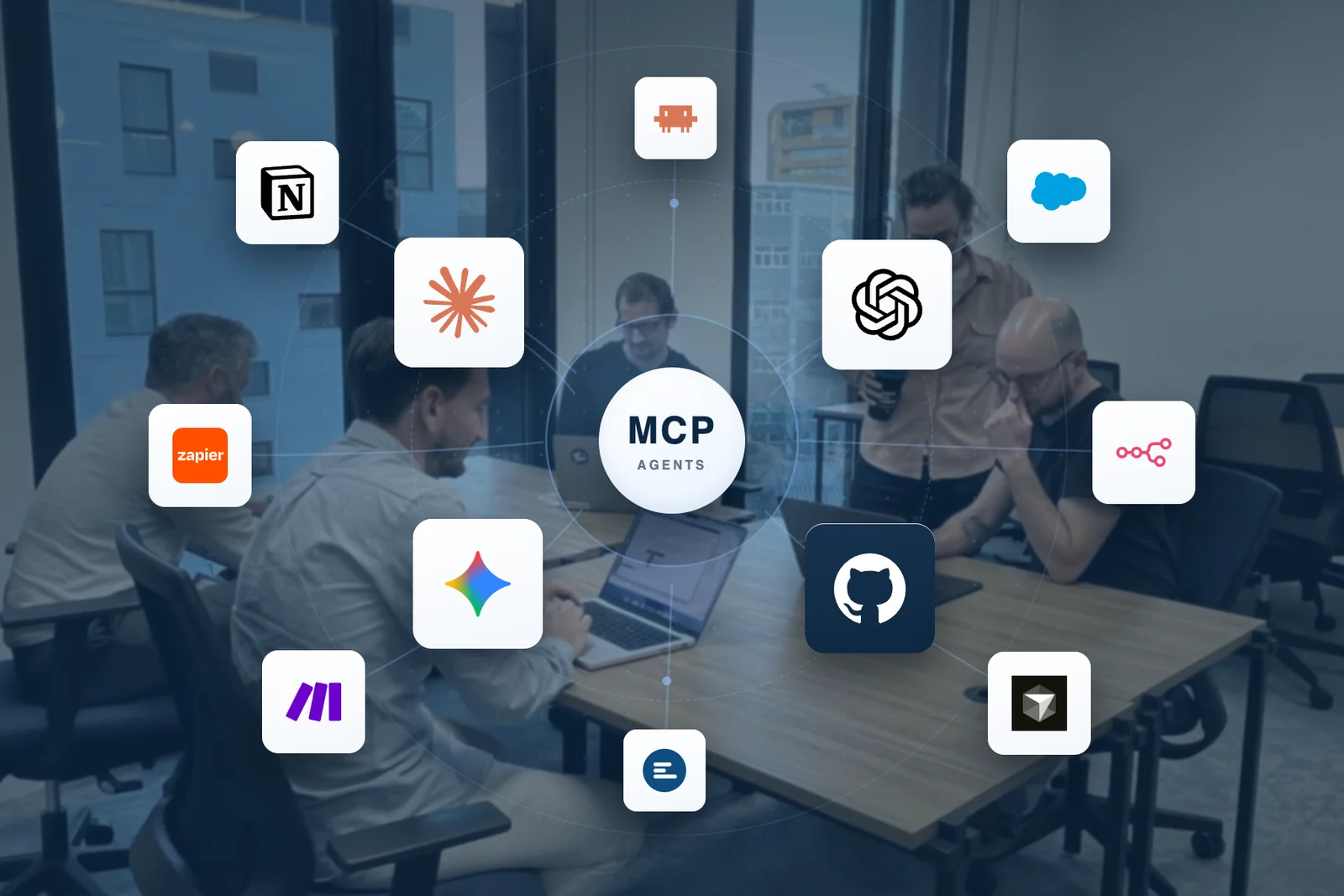
Flow automation with AI blocks (n8n, Make, Zapier) chains actions between tools: a submitted form triggers an email, a row in a spreadsheet, and so on, with AI added on top. Zapier has launched its Agents across more than 8,000 connected applications, Make has its Maia, n8n ships native AI nodes. Our reading: useful for automations that are already proven, but it is not where we would invest first in 2026. These flows are hard to maintain, every API change breaks something, and a frozen flow is a poor match for what an agent does best: understanding context and adapting. It is the fastest-ageing approach of the four.
AI and agentic platforms are the current centre of gravity. They are the environments where you govern agents: they connect to the company's tools through MCP (the standard that acts as a universal plug between an agent and your software), carry shared assets (agents, skills, plugins) and provide the administration that goes with it: permissions, security, cost tracking.
Two sub-groups to distinguish. The generalists first: Anthropic's Claude (Team and Enterprise plans), OpenAI's ChatGPT, Google's Gemini Enterprise with its no-code agent building layer, Microsoft Copilot for the 365 universe. This is where the platform choice happens for most companies. Then the embedded ones, native to a business tool: Salesforce Agentforce for those who live in that CRM, Notion and its Custom Agents (more than a million created since February 2026). Powerful within their perimeter, they are not designed to become your central platform, unless that tool is already the heart of your organisation.
One fact structures all of this: every one of these players has converged on MCP, launched by Anthropic then adopted by OpenAI and Google in 2025. Concretely, the work you invest in connecting your data remains largely portable from one platform to another.
The IDE ecosystem (Claude Code, Cursor, Codex) puts the agent to work directly in files and code. Born for developers, it reaches far beyond its original audience: it is the cockpit where connectors and skills get built, and where data profiles get the most spectacular gains today. A CMO's starting point is elsewhere. Their data team, however, will spend its days there.
Custom, finally: your own front end, your own back end, models called through APIs or deployed in-house. Maximum control, maximum cost of ownership too, since you rebuild what the platforms already provide as standard, and the gap narrows with every new release. Justified for a product aimed at your own customers, or for strong sovereignty or volume constraints. As the internal foundation of a marketing team, we reserve it for a few well-identified use cases. Making it the backbone of your setup is something we advise against.
 n8n
n8n  Make
Make  Zapier
  Claude
  ChatGPT
  Gemini Enterprise Copilot
  Agentforce
  Notion
  Claude Code
  Cursor Codex
 Data and marketing: what to activate depending on your size
At large accounts and companies already mature on the subject, the question is usually settled elsewhere. Company directives, carried by IT and security, frame the choice between an enterprise AI platform and custom builds, often both at once. Our role in that case is not to replay that infrastructure choice. It is to build the marketing and data use cases within the frame that has been set.
For SMBs and marketing teams that keep control of their choices, two recommendations, stated plainly.
First: move forward with an AI platform that suits you, on an enterprise plan, Team or Enterprise depending on the scale of the rollout. Claude, ChatGPT, Gemini Enterprise: all three are serious options. That plan is mandatory: it is what brings the non-use of your data for model training, centralised access management and asset sharing across the whole team.
The choice between the three depends mostly on your existing stack, Google or Microsoft suite, your teams' preferences, more than on any absolute ranking: the leading models are within six months of each other and all keep improving.
Second: build your use cases as assets, not as prompts living in one person's head. A use case that lasts ticks five boxes.
- It is personalised to your business, your definitions, your rules, your subtleties: that level of detail is what makes the answer right.
- It is agnostic and portable: versioned files, open standards, nothing that lives only in a vendor's interface.
- It is shared with the organisation, with an identified owner who maintains it.
- It is secured: access rights, no secrets in plain text, sensitive write actions locked, consumption tracked.
- And it is adopted: start small, iterate with the users, measure.
To verify in your own context, but this is the structure we find in the systems that last beyond six months at our clients.
How we organise ourselves at EdgeAngel
Our setup comes down to two building blocks.
Claude, on an enterprise plan, is the platform where the team works. Company rules and cybersecurity are set at the organisation level: access, permissions, no credentials in plain text thanks to a secrets manager, write actions on client tools locked by default.
GitHub is our asset vault. All our connector configurations and all our use cases are versioned there, reviewed, and automatically distributed to the team's machines. Know-how that is not in the repo, for us, does not exist.
Two technical words, two simple images.
- MCP is the standard that connects an agent to your tools (advertising platforms, analytics, data warehouse) to fetch the right context at the right time: a universal plug, of sorts.
- Skills, grouped into plugins, are files that encode our marketing and data use cases: how we produce a monthly report, how we audit an account, with which rules and which data.
Two things change everything, in our view. We share these assets with our clients: they access their data and their use cases in their own environment, with the same level of rules as ours. And portability, we have tested it for real: we were intensive users of Google's agentic environment, and we migrated the whole team to Claude in less than a day, without rewriting our assets. They were in GitHub, the connections were standard MCP. If we have to change provider again tomorrow, we can. It has been a design criterion from day one, not an after-the-fact argument.
Two building blocks, shared with the team and with clients
how EdgeAngel is organised, in short
1 · The platform
Claude, on an enterprise plan
Where the team works. Company rules and cybersecurity set at the organisation level.
2 · The asset vault

GitHub
Connectors and use cases versioned and reviewed, like code.
automatic distribution
The team
EdgeAngel consultants
Every machine receives the same connectors and the same skills, up to date. An improvement benefits everyone.
Our clients
In their own environment
Their data, their use cases, the same level of rules as ours.
Files and open standards: changing provider puts nothing at risk.
EdgeAngel
A real use case: when marketing data answers right
The use case creating the most value at our clients today has three layers, and the first one does not even mention AI.
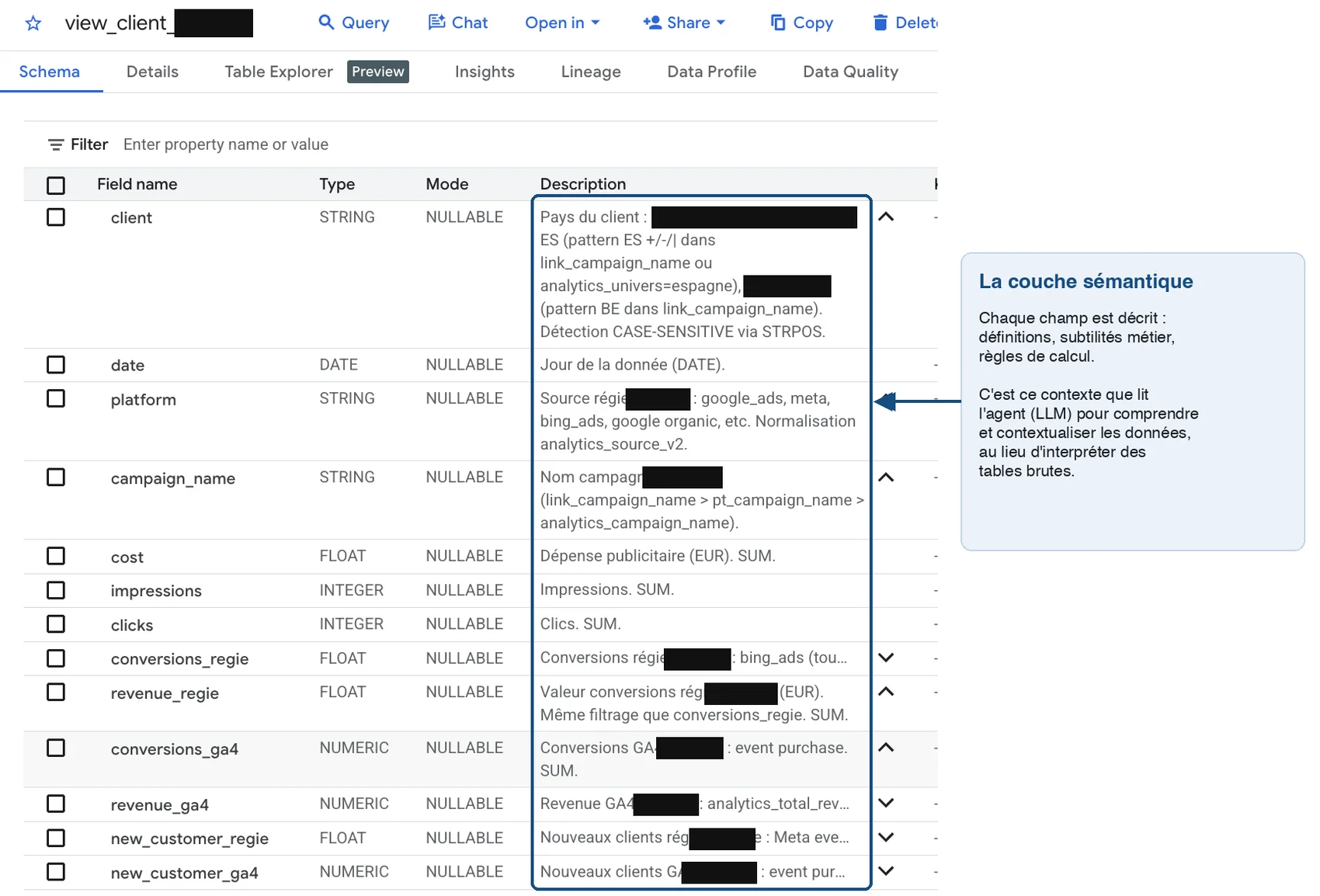
Layer one, centralise and document. The client's marketing data (media, analytics, CRM, back office) lands every day in their warehouse, most often BigQuery, through Capture, our in-house ETL tool: daily sync, normalisation, historisation. On top of it, we build a semantic layer, the documentation that defines every metric and records the subtleties of every source.
A real example, taken from a client account: country detection is done by pattern matching (a rule that spots the country in the campaign name, letter by letter, with precise casing) plus a fallback rule on another source when the pattern is missing, to avoid false positives. That kind of detail, written down in black and white, is what separates a right number from a wrong one.
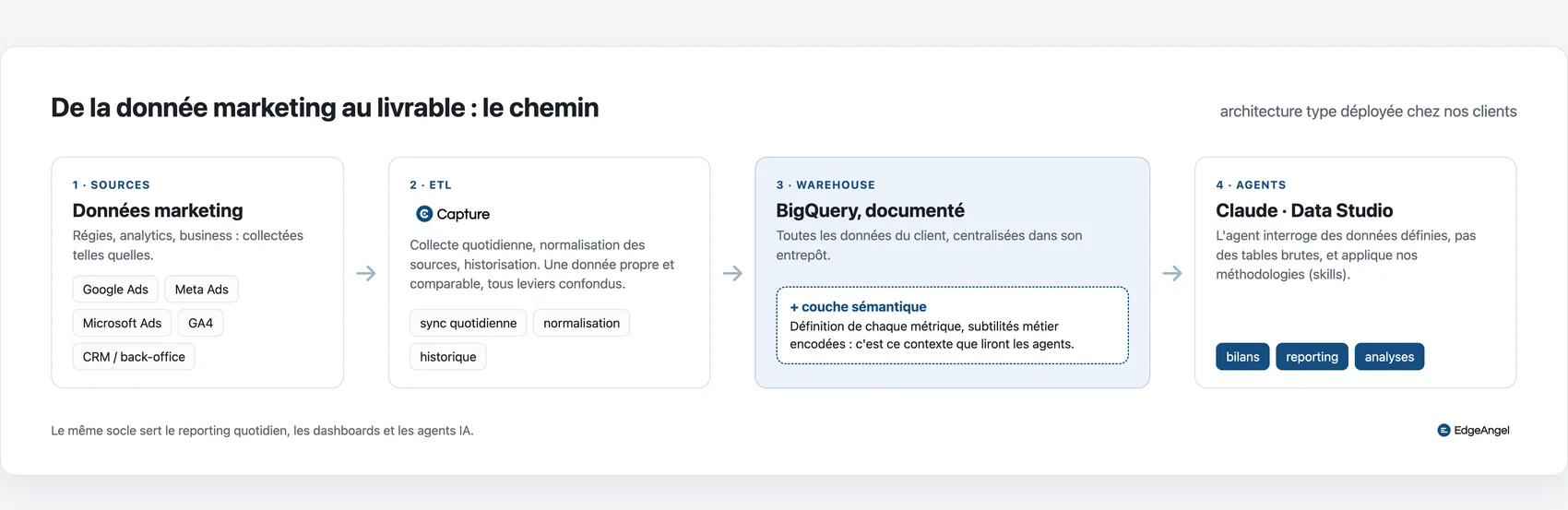
Layer two, expose to the agents. That documented warehouse is connected to Claude and to conversational dataviz tools. The agent can then fetch, precisely, without hallucinating. What makes it reliable lies in the documentation it reads: definitions written by people who know the account. The same agent plugged into raw tables, without that layer, would answer fast. And wrong.
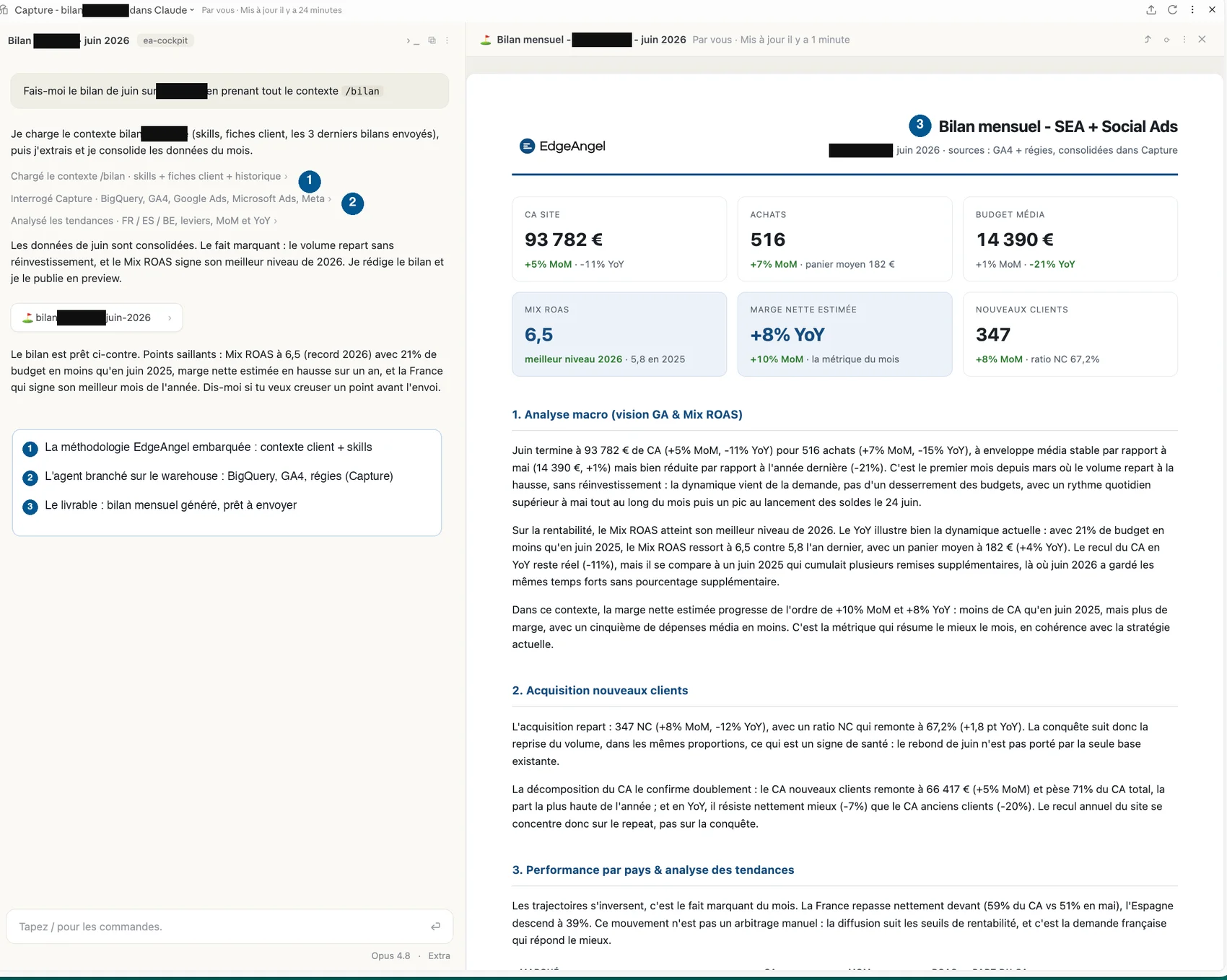
Layer three, encode the usages as skills. Every
month, a consultant types a command, /bilan, followed
by an instruction in plain language. The agent loads the context
(skills, client file, history of previous reports), queries the
warehouse and the ad platforms, analyses trends by country and by
channel, then generates the formatted report, ready to send.
What it changes, concretely:
- finer reporting than before, at equal effort;
- analyses we would never have had the time to run: crossing segments, decomposing a variation, hunting an anomaly across an entire history;
- and consultant time reinvested where it counts most, interpretation and prioritisation of actions.
These assets are created and maintained by our experts.
Two prerequisites, without which none of this holds.
- Reliable data: tracking and collection come first, and they are a craft of their own.
- And a documented agentic architecture, which mobilises the right skill and the right context at the right time. Without it, an agent stays at the level of the plausible, and mechanically, regularly, produces wrong answers.
Where to start, concretely
Two steps, in this order.
First, identify the use cases that create value for you. Two veins to dig: the performance of your campaigns, and the time you lose on repetitive tasks.
- reporting and monthly reviews;
- spotting media opportunities;
- performance analysis;
- advertising effectiveness measurement;
- anomaly detection on the site;
- competitive monitoring.
All worth scanning. The right filter comes down to one question. What is done by hand today, repetitively, by competent people? That is augmentable.
Then, deploy an AI platform and translate those use cases into agentic assets, progressively. An enterprise plan, a first connector to your data, a first encoded use case, iteration with the teams using it. No grand revolution: move step by step, and each asset that creates value in real use opens the way to the next one.
EdgeAngel supports its clients on AI-powered data marketing. Our consultants build and maintain the agentic assets, data connections, use cases, security rules, that improve performance across the whole marketing chain, from data collection to campaign management.
Frequently asked questions
Which AI platform should an SMB choose?
It depends on your existing stack: Google suite, Gemini Enterprise; Microsoft suite, Copilot. With no strong preference, Claude and ChatGPT are within a few months of each other. The non-negotiable point remains the enterprise plan, Team or Enterprise depending on your size.
Do you need a data warehouse before starting?
Yes, it is clearly recommended as soon as you cross data sources (media, CRM, analytics). Without centralised, documented data, an agent answers fast and off the mark: plugging it into your tools without context is the best way to get irrelevant analyses and recommendations.
Is a no-code tool (n8n, Make, Zapier) enough?
For automations that are already stable, often yes. For a use case that needs to adapt to context, it ages poorly.
Sources and references
- Model Context Protocol (MCP) — the standard, initiated by Anthropic
- Claude for organisations (Team and Enterprise plans) — Anthropic
- ChatGPT for business — OpenAI
- Gemini Enterprise — Google Cloud
- Microsoft 365 Copilot — Microsoft
- Zapier Agents — Zapier
- Maia, Make's AI assistant — Make
- Native AI in n8n — n8n
- Notion AI and agents — Notion
- Agentforce — Salesforce
Talk about your project
A first conversation to identify your use cases and where to start on your side. The details of our support are on the AI-Powered Marketing page.